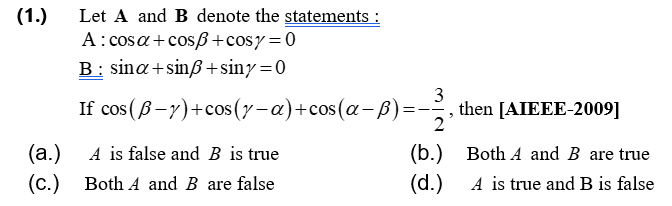
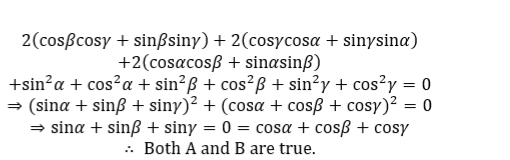
Important questions for JEEAnswer: (C) Both A and B are True
Question:
Let cos(α + β) = 4/5 and sin(α − β) = 5/13, where 0 ≤ α, β ≤ π/4. Then tan 2α = ?
Answer: (b) 56/33
Given:
cos(α + β) = 4/5
∴ sin(α + β) = 3/5
sin(α − β) = 5/13
∴ cos(α − β) = 12/13
tan(α + β) = (3/5)/(4/5) = 3/4
tan(α − β) = (5/13)/(12/13) = 5/12
tan 2α = tan[(α + β) + (α − β)]
= (3/4 + 5/12) / (1 − (3/4 × 5/12))
= 14/12 ÷ 33/48
= 56/33
∴ tan 2α = 56/33
For a regular polygon, let r and R be the radii of the inscribed and circumscribed circles. A false statement among the following is:
Answer: (c) 2/3
For a regular n-sided polygon:
r/R = cos(π/n)
Now check each option:
(a) 1/2 = cos(60°)
Possible for n = 3
(b) 1/√2 = cos(45°)
Possible for n = 4
(d) √3/2 = cos(30°)
Possible for n = 6
Now,
(c) 2/3
There is no integer n such that:
cos(π/n) = 2/3
Hence this is not possible for any regular polygon.
∴ The false statement is (c) 2/3
Let cos(α + β) = 4/5 and sin(α − β) = 5/13, where 0 ≤ α, β ≤ π/4.
cos(alpha + beta) = 4/5 and sin(alpha - beta) = 5/13
Find tan 2α (tan 2alpha trigonometry identity question)
cos(α + β) = 4/5 ⇒ sin(α + β) = 3/5
sin(α − β) = 5/13 ⇒ cos(α − β) = 12/13
tan(α + β) = 3/4, tan(α − β) = 5/12
Final Answer: tan 2α = 56/33